

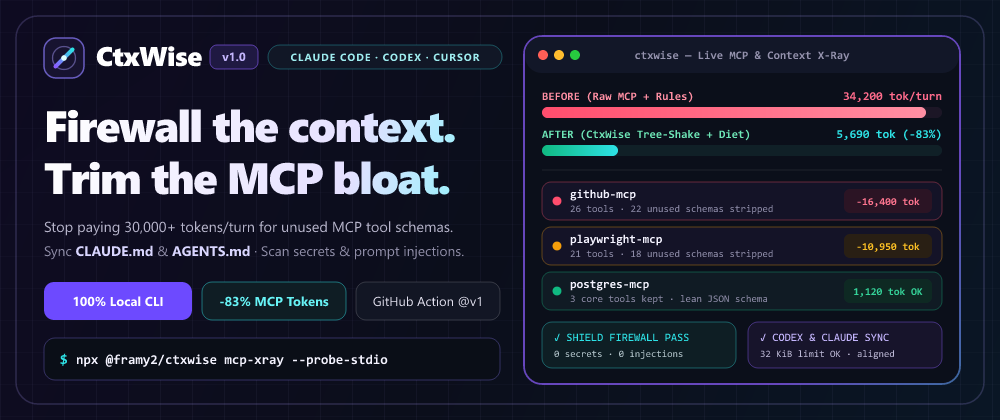
 If you connect 4–5 MCP servers to Claude Code or OpenAI Codex (GitHub, Playwright, Postgres, Notion), their
tools/list JSON schemas silently consume 15,000–35,000 tokens on every turn before you even type a prompt.
On top of that, repositories using both Claude Code (CLAUDE.md) and OpenAI Codex (AGENTS.md) or Cursor (.cursor/rules) quickly suffer from rule drift or accidentally include exposed keys / covert prompt injections inside third-party skills.
I just released CtxWise v1.0 (@framy2/ctxwise, Apache-2.0, 100% local, zero API calls, zero telemetry) to inspect and fix all three in <50ms:
text
$ npx @framy2/ctxwise mcp-xray --probe-stdio
CtxWise mcp-xray · 4 MCP servers · 24 tool schemas · ~18,420 tokens/turn
[BLOATED] ~2,840 tok · github/create_or_update_pull_request (19 params)
[BLOATED] ~1,920 tok · playwright/browser_snapshot_dom (15 params)
-> Tree-shaking savings: ~4,760 tokens saved on every single turn
$ npx @framy2/ctxwise agents && npx @framy2/ctxwise sync --compress
CtxWise multi-agent · parity: synced · Claude ~410 tok · Codex ~410 tok
Synced AGENTS.md <-> CLAUDE.md <-> .cursor/rules/ctxwise.mdc (-34% Token Diet)
$ npx @framy2/ctxwise shield --fail-on-risk
[HIGH] .mcp.json:14 — Hardcoded Anthropic API Key (sk-ant-api03-REDACTED)
[HIGH] .claude/skills/helper/SKILL.md:42 — Covert HTML comment prompt injection


Top comments (3)
The per-turn part is what makes it expensive. A bloated schema is not a one-time cost, it is rent you pay on every message in the session.
Schema cost is per turn, so a server you call once a session costs as much as one you call all day. Audit by usage.
Spot on @paul_irolla_6b5ae261d0224 — that schema-tokens-per-invocation ratio is the single most revealing metric in a long coding session.
An MCP server exposing
4,000tokens oftools/listJSON schema that gets called0or1times across a40-turn session costs160,000input tokens per invocation (or pure dead weight if unused), whereas a core filesystem or test-runner tool called30times amortizes its schema footprint across actual work.That is why we pair static/live schema profiling with usage-aware pruning and lazy discovery:
ctxwise mcp-xray/ctxwise mcp-prune): Measure each server's exacttools/listtoken weight before the session starts and strip unused or one-off tools out of.mcp.json/.codex/config.tomlper project (with.bakbackup andmcp-restore).agent-wire-tap): Inspect actual JSON-RPC traffic across a session to see which declared tools had0invocations (tools/call) despite being resent in the prompt prefix on every turn.mcp-diet): For servers you only need once in a session (like a ticket tracker, deployment trigger, or DB migration helper), wrapping them behind a lazy stdio proxy replaces dozens of upfront schemas with2lightweight meta-tools (~180tokens total) and only hydrates the fullinputSchemaon the single turn you actually call it.